Not every elephant safari is chasing the same moment. Some travelers want to sit with a family group for 40 minutes watching a calf stumble into a water hole while the matriarch positions herself between her youngest and your vehicle. Others want the singular visual weight of a massive old bull walking alone across open country, tusks so long they drag grooves through the dust.
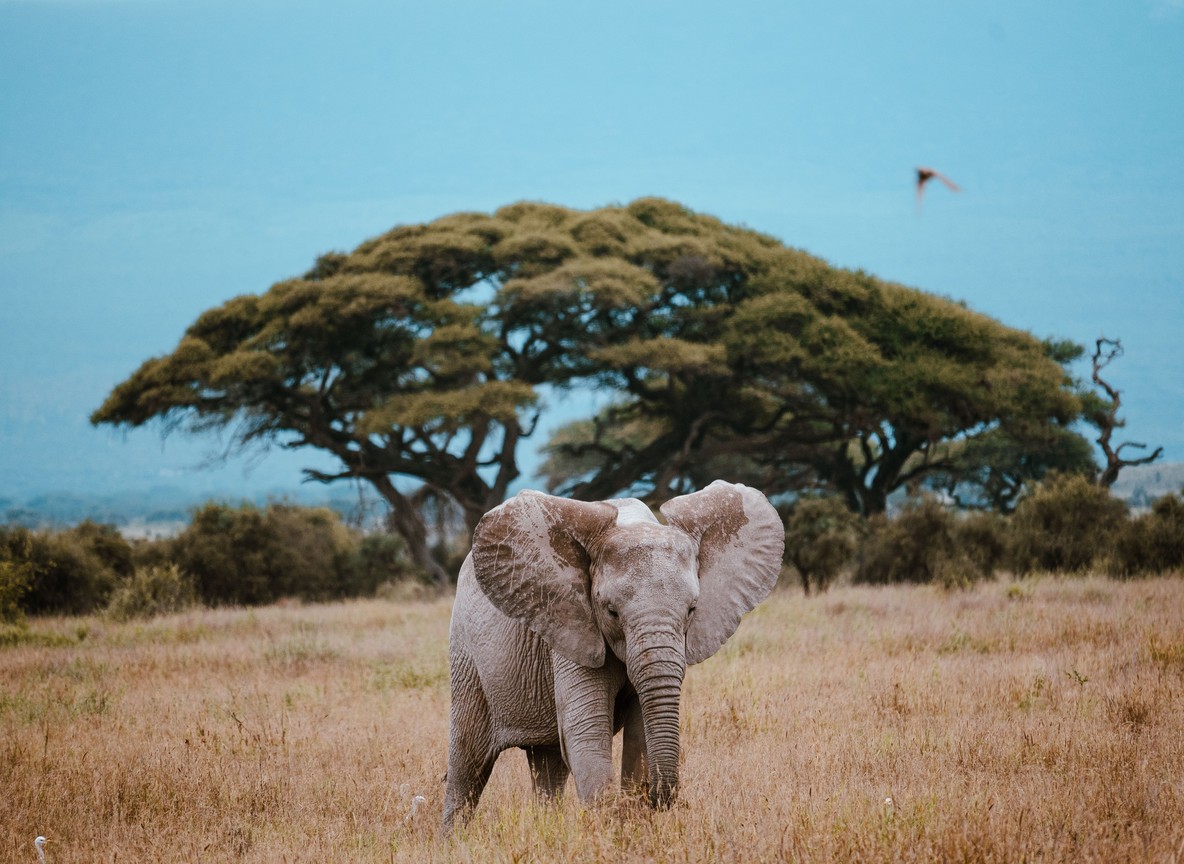
Elephant family herds vs big tuskers in Amboseli is one of the most practical planning questions you can ask before a Kenya safari. Both experiences exist in the same park. Both are genuinely exceptional. But they reward different things, and knowing which one matters more to you will shape how you structure your days.
Amboseli is unusually well suited for both. Its decades of elephant research through the Amboseli Elephant Research Project (run since 1972) mean family group behavior is documented and, in the field, strikingly readable. Its open, flat terrain and mature bull population keep the big-tusker possibility alive across all seasons. The question is not which is objectively better. It is which one you came for.
The Short Answer
Choose family herds if you want:
- Social behavior you can read and follow in real time
- Calves, juveniles, and matriarch leadership decisions
- Emotional storytelling across a long sighting
- Repeated encounters that build in depth across multiple drives
Choose big tuskers if you want:
- Rarity and the weight of encountering something diminishing
- Visual scale that makes a single photograph stand on its own
- A more solitary, less predictable kind of sighting
- Portrait-style elephant photography
Most good Amboseli safaris include both. But most travelers lean hard toward one, and it is worth knowing which.
Why Family Herds Are Central to the Amboseli Experience
Amboseli’s elephant families are among the most studied in Africa. The Amboseli Elephant Research Project has tracked individual animals across generations, which means guides with real knowledge of the population can identify matriarchs, name family groups, and explain what you are watching.
That context changes everything. When you see a young female intercept a calf who has wandered too far, it reads differently if you know she is the matriarch’s daughter rather than just a random adult. When the whole family reacts to a sound from the treeline, you understand the matriarch’s ears-forward assessment as a leadership decision, not an automatic reaction.
Family herds are also the backbone of the Amboseli visual experience. The classic Amboseli image, the one with a line of elephants moving across open swamp with Kilimanjaro behind, is almost always a family group. You cannot replicate that with a solitary bull.
For first-time visitors, naturalists, and anyone who wants to understand elephant society rather than merely observe individual animals, family herds are the right focus.
Why Big Tuskers Have Their Own Pull
A true big-tusked bull is something else entirely. Amboseli has historically carried some of Kenya’s most famous ivory bulls, and while the population of extreme tuskers is smaller than it was a generation ago, encounters still happen.
When you see one, the effect is immediate. There is a weight to a mature bull with tusks that sweep outward past his knees. He does not look like a family elephant. He looks like something from a different era of Africa.
For photographers, solitary bulls offer clean portrait conditions. No moving group of animals, no calves cutting across the frame, no competing subjects. The bull is your subject, the plain is your background, and if the light is right you get something that stands alone.
For repeat safari travelers who have already internalized what family groups feel like, a big-tusker encounter often becomes the trip’s headline moment precisely because of its rarity.
Photography: Where Each Type Excels
Family herds are stronger for:
- Layered compositions with multiple animals at different distances
- Calf interaction scenes: nursing, playing, crossing water
- Behavior sequences you can follow frame to frame
- Emotional storytelling through relationships
Big tuskers are stronger for:
- Single-animal portrait work with clean sky or plain behind
- Images that communicate scale through composition
- Minimalist frames where one animal owns the landscape
- High-impact shots that need no supporting characters
Photographers tend to know which they want very quickly. Behavior shooters almost always prefer family herds. Portrait and icon shooters lean toward bulls. The honest advice is to clarify your photographic goal before you arrive rather than hoping to do both equally well.
Explorer Notes: Reading the Amboseli Elephant Scene
A few field observations worth keeping in mind before your drives:
On family groups: The matriarch sets the pace and direction. Watch her ears and posture, not the calves. If she is relaxed, feeding slowly, the group tends to hold. If she starts moving purposefully, the whole family follows within minutes. Early morning is when families often move from sleeping areas toward the swamp. Late afternoon is when they return.
On bulls: Solitary males appear throughout the year, but dry season concentrations around the swamp make sightings more predictable. A bull in musth is identifiable by temporal gland secretion running down the side of his face, wet legs from dribbling urine, and a more deliberate, sometimes restless movement pattern. Guides give musth bulls additional distance, and for good reason.
On the swamp: Amboseli’s swamp zone, fed by underground water from Kilimanjaro, is the park’s wildlife hub. Both family groups and bulls congregate here, particularly in the dry months of July through October and January through February. A morning spent near the swamp edge is often the most productive elephant-watching session you will have.
On timing: The classic Kilimanjaro backdrop appears most reliably in the very early morning before cloud builds up. Plan your first drive to be in position near the swamp before 7am if you want the mountain behind your elephants.
How Trip Length Changes the Calculus
On a short safari, two to three nights, family herds are the more dependable foundation. They are a predictable part of the Amboseli experience, they offer multiple satisfying encounters across a short visit, and they do not ask you to build the entire trip around one rare bull.
On a longer safari, four nights or more, the big-tusker search becomes easier to justify. You have time to absorb both. Family herd encounters fill the morning and evening drives naturally, and the bull search can become a deliberate thread running through the trip without it feeling like a gamble.
Quick Comparison
| Factor | Family Herds | Big Tuskers |
|---|---|---|
| Behavioral depth | High | Moderate |
| Emotional storytelling | High | Moderate |
| Rarity and drama | Moderate | High |
| Best for first-time visitors | Yes | Supplement |
| Portrait photography | Moderate | High |
| Repeatability across drives | High | Lower |
| Kilimanjaro backdrop shot | Yes | Possible |
Conclusion: Understand or Be Stunned
These are not competing experiences. They are different answers to the question of what you want an elephant encounter to do for you.
Family herds teach you something. You leave understanding how elephant society works, how leadership moves through a group, how calves are raised by a community rather than a single mother. The knowledge stays with you.
Big tuskers stun you. There is no sequence of observations, no building understanding. There is just a moment of visual impact that holds in memory for a long time.
The best Amboseli safari makes room for both. But if you have to choose a primary focus, choose honestly. That single decision shapes your drives, your timing, and how much patience you bring to each sighting.
Next Steps
For a broader look at planning your Amboseli safari, see the Amboseli National Park guide on touringinsights.com. For comparison with other Kenya parks strong on elephants, see the guide to Amboseli vs Tsavo elephants and the Amboseli elephant research project overview.
For official park information, the Kenya Wildlife Service carries current park fees and entry conditions.
Turn this reading into a real itinerary with help from a Kenya-based safari team.
Start Planning Your Safari